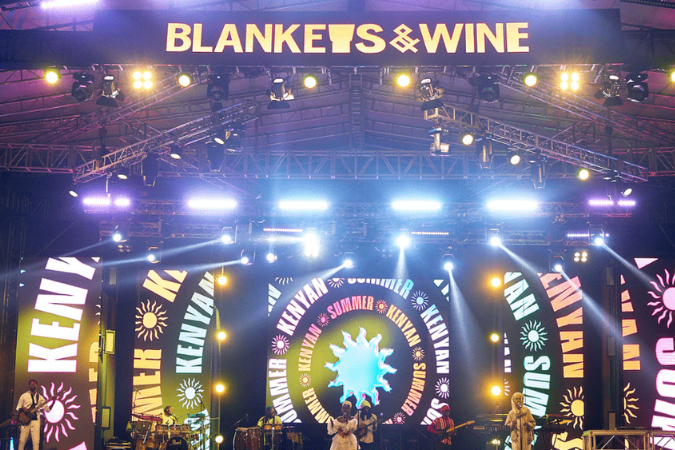
- Tickets sell out.
- Fans return, edition after edition.
- There’s ritual.
Blankets & Wine brought in Tems last year. The lowest ticket was KES 5,000.
It sold out.
That doesn’t happen accidentally. There’s consistency. There’s identity. There’s trust. And perhaps most importantly, there’s culture.
Before we go further, it’s important to acknowledge something: film operates under very real structural constraints: Limited cinema screens. Distribution bottlenecks. Funding gaps. Policy inconsistencies. Longer production cycles.
This reflection isn’t ignoring that.
It’s simply observing that within the same creative economy, another sector has built steady momentum.
So what exactly has music done well?
Let’s break it down practically.
1. Consistency
Recurring events create rhythm; Blankets & Wine isn’t a one-off. Solfest isn’t experimental every year. Audiences know it’s coming back. That predictability builds loyalty.
2. Clear Audience Identity
These events know who they are for. They’ve built aesthetic cohesion, even fashion culture around them. Blankets & Wine editions often carry a style identity. Solfest has a recognizable vibe and positioning. People don’t just attend, they dress for it, they document it, they belong to it.
3. Experience Beyond the Performance
It’s not just about music.
It’s:
- Fashion installations
- Social currency
- Brand activations
- Community gathering
4. Ticketing Culture
Audiences are used to paying. Not reluctantly, not apologetically, paying is part of the ritual. And that culture didn’t appear overnight, it was nurtured.
Music events have also made paying flexible. Tiered ticketing models: early bird, regular, VIP, season passes, allow audiences to buy when they can.
If an event is happening in April but someone has money in January, they can secure their ticket early.
That flexibility builds commitment long before the event date. It also spreads financial pressure across time.
That kind of structuring doesn’t just sell tickets. It builds anticipation.
5. Structured Brand Integration
Look at the partnerships:
For Solfest 2025: Blankets & Wine:
- Tusker Cider as official beer partner
- British Council as cultural partner
- Fashion brands like Adele Dejak and Republi.ke integrating into the experience
The Trust Equation
What music has built over time is reputation.
- Audiences trust the experience will deliver.
- Brands trust audiences will show up.
- Investors trust the brand has cultural credibility.
Which brings us back to film.
This is not about comparison. It’s about reflection.
As filmmakers, we might ask ourselves:
- Do we have recurring film events with loyal audiences?
- Do audiences feel ownership of our screenings?
- Are our premieres events or simply screenings?
- Do we build anticipation months in advance?
- Do we treat each screening like an experience?
- Could we experiment with pre-sale models or early ticket commitments when we know our release timelines, even within the constraints of cinema programming?
And We Are Not Starting From Zero There are models within film that are working.
Take Shorts, Shorts & Shots by Docubox.
Running since 2018, it has built a quarterly ritual around short films in Nairobi. Its format is simple but powerful: “You wear the shorts, we screen the short films, we all have shots.”
It blends:
- Fashion
- Film
- Themed programming
- Q&As with creators
- Social interaction
- Networking
- NBO Film Festival
- Kitale Film Week
- Kilifi Film Festival
These are cultural foundations.
They prove that when film is framed as experience, not just content, audiences respond.
Beyond festivals, we’re also seeing independent curators build film-centered experiences in existing spaces.
Events like Movie Nights by Mugambi and The Cinema Garden create communal screening environments outside traditional cinema structures. They tap into outdoor spaces, curated programming, and social energy to introduce films to new audiences sometimes people who may not regularly attend cinemas.
These initiatives remind us that experience design around film does not always have to begin inside a multiplex. Sometimes it begins with space, curation, and intention.
The Responsibility Question
It’s easy in our industry to say: “Audiences don’t show up.” A harder, and perhaps more empowering question might be: What is our responsibility in creating the conditions for them to show up?
Not individually.
Collectively.
How do we:
- Build recurring touchpoints?
- Strengthen anticipation cycles?
- Develop recognizable screening identities?
- Think of films as brands, not just projects?
- Treat premieres as cultural moments?
A Nuanced Ending
Film and music are different products; production timelines differ, economics differ, revenue models differ, scale differs. But culture-building? That part may not be so different. If sustainability is the long-term goal, perhaps it does not begin with funding. Perhaps it begins with culture. And culture is something we build slowly, intentionally, together.